
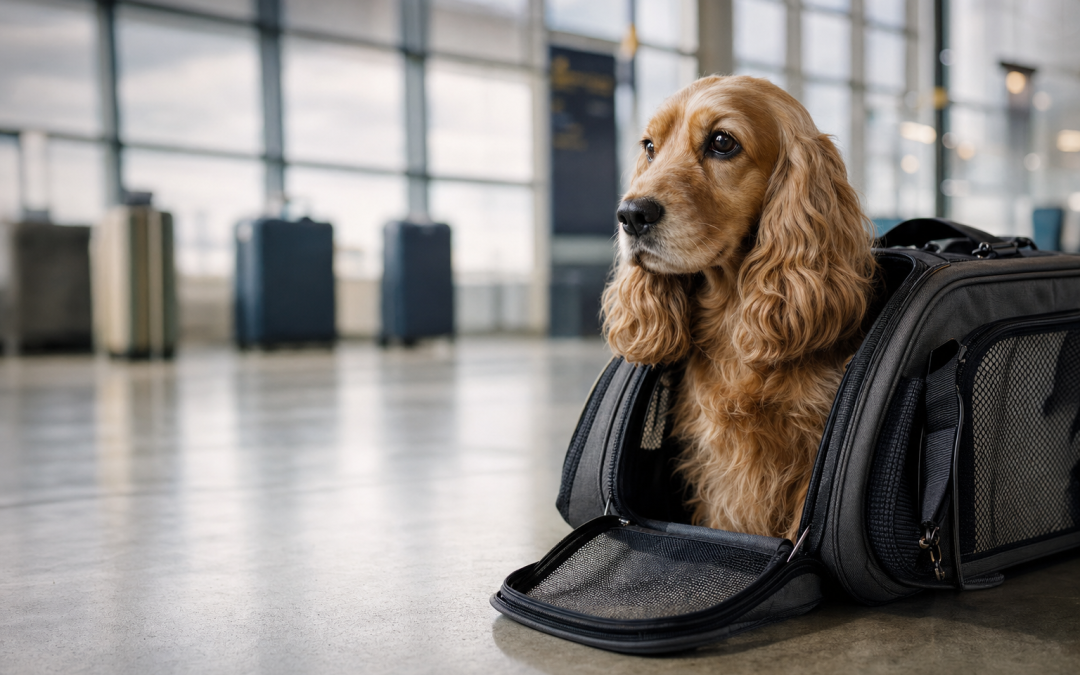
Flying internationally with your dog is one of the most paperwork-heavy travel scenarios you can take on. Miss a single document or vaccine deadline and the airline can refuse boarding, customs can hold your dog in quarantine, or you can be turned back at the border. This checklist sets out the planning framework and points you to the official authority for each destination, because those authorities are the only source that is current for your route.
Disclosure: This article contains affiliate links. If you buy through our links, we earn a small commission at no extra cost to you. We only recommend gear that meets our research criteria.
Important caveat: Country-specific rules change, and they change without much notice. Every requirement below must be confirmed against your airline and the destination country’s own animal import authority before you book and again before you fly. This checklist is a planning framework, not a substitute for current official guidance.
The 90-day pre-flight planning timeline
Most international dog travel requires actions spread across 60-90 days before flight. Compressing the timeline rarely works because rabies antibody tests, vaccination waiting periods, and document endorsements have fixed minimum durations that cannot be sped up.
90-60 days before flight
- Confirm destination import rules at the official source. For the EU, the European Commission entry-into-the-Union pages. For Great Britain, gov.uk pet travel. For the United States, the CDC dog importation pages. For Australia, the Department of Agriculture, Fisheries and Forestry at agriculture.gov.au. If you are exporting from the US, USDA APHIS handles the export health certificate and its endorsement.
- Have your dog’s microchip implanted and registered, and check that it meets the destination’s standard. The European Commission requires an approved microchip, and the vaccination date must not precede the date the microchip was implanted or read. The CDC states the microchip may be any brand as long as it is detectable with a universal scanner, and that it must be implanted before the rabies vaccine or the vaccination is not valid.
- Check whether your destination requires a rabies antibody titration test. It is not universal. The EU requires it only for dogs coming from certain listed countries. Where the EU does require it, the blood sample must be taken at least 30 days after the primary vaccination and not less than 90 days before the health certificate is issued, so it has to be scheduled early.
- Choose your airline and confirm in writing that it carries dogs on your specific route, in cabin or as cargo. Airline pet policies differ by carrier, by route and by aircraft, and they change. Do not assume a carrier accepts pets because it did previously.
- Book a vet appointment for a baseline health exam. Note your dog’s exact measurements and weight and any chronic conditions, since these affect crate sizing and airline acceptance.
30-21 days before flight
- Rabies vaccination must be current and old enough. Both the EU and Great Britain require at least 21 days to pass after the primary vaccination before entry. The EU also requires the dog to have been at least 12 weeks old at the time of that vaccination.
- Some destinations require additional vaccinations or parasite treatments. Check the destination authority rather than assuming a standard panel.
- Schedule the appointment for the health certificate with a vet accredited for export in your country. For entry to the EU, the animal health certificate is valid for 10 days from the date of issue until the documentary and identity checks at the point of entry, so the appointment has to be timed against your departure date.
- Buy the travel crate now if you do not own one, so there is time for the dog to get used to it before departure.
10-7 days before flight
- Final vet visit for the health certificate. Bring vaccination records, microchip documentation, any titer results, and your itinerary.
- Government endorsement of the certificate where required. In the US this is done through USDA APHIS. Confirm the current endorsement timing and process directly with APHIS, since it varies by destination country and by whether the certificate is submitted electronically.
- Re-confirm crate dimensions and fittings against the airline’s own published requirements.
- Notify the airline of pet travel and get written confirmation of the booking. Ask the airline how far ahead it requires this.
2-1 days before flight
- Pack carrier essentials: absorbent pad, water container fitted to the crate door, food in a sealed bag attached to the crate, and copies of all documents in a waterproof pouch attached to the crate.
- Ask your vet how to handle feeding on the day of travel. Guidance depends on the dog, the flight length and the departure time, so get it from the vet who knows the animal.
- Do not sedate without explicit veterinary direction. IATA “continues to endorse recommendations not to sedate or tranquilize pets or other animals in transit”, and states that any medication must be veterinarian-directed and noted on the health certificate.
- Print several copies of every document. Keep originals plus backups in separate places.
The document checklist
These are the documents commonly required on international routes. Which ones apply, and in what form, depends entirely on your destination. Confirm the list against the destination authority.
- Microchip number with registration confirmation, implanted before rabies vaccination
- Current rabies vaccination certificate with vet signature, date and product information
- Rabies antibody titration test results from an approved laboratory, if your destination requires the test
- Health certificate in the form the destination requires. For entry to the EU this is an animal health certificate issued by an official veterinarian, valid for 10 days to the point of entry. Country-specific certificate forms are published by the destination authority and, for US exports, by USDA APHIS.
- Government endorsement on the health certificate where the destination requires it
- Import permit where required. Australia requires a valid biosecurity import permit before the animal travels. Other countries have their own permit systems, so check yours.
- CDC Dog Import Form receipt if you are entering the United States
- Additional vaccination or treatment records per destination requirements
- Airline pet booking confirmation in writing
A note on EU pet passports: the EU pet passport is a document issued to pets resident in the EU and certain listed territories. A dog arriving from a non-EU country travels on an animal health certificate instead, not a pet passport. If you are moving to the EU, ask your vet there about getting a passport issued after arrival for later travel within the EU.
Travel crates and IATA requirements
Your dog’s crate must satisfy both the airline and, for cargo travel, the IATA Live Animals Regulations. IATA states that a container must allow the animal “to turn about normally while standing, to stand and sit erect, and to lie in a natural position”, and that snub-nosed breeds require containers 10 percent larger than the standard calculation.
Beyond that size rule, the detailed construction requirements (materials, door and locking type, number of ventilated sides, labelling and orientation markings, and food and water containers) are set out in IATA’s Container Requirement 1 within the Live Animals Regulations, and individual airlines add their own conditions on top. Get the current requirements from IATA and from your airline in writing before you buy a crate. A crate that fails inspection at check-in means your dog does not fly.
Soft-sided carriers are accepted by some airlines for in-cabin travel but are not suitable for cargo. Confirm the specific carrier you intend to use with the airline, for your route, before you buy.
For the crate itself, see our guide to collapsible travel crates, though for international flights in cargo you will need a rigid crate that meets IATA and airline requirements, not the collapsible variants useful for car travel.
Pre-flight crate training
Give your dog several weeks to get used to the crate before an international flight. The flight environment brings engine noise, vibration and temperature changes, and a dog who has not been positively conditioned to the crate has a much harder time with it.
A workable progression:
- Week 1: Open crate in the living area. Feed all meals inside with the door open. Add comfort items such as a blanket or a toy with your scent.
- Week 2: Close the door for 5 minutes, then 15, then 30. Reward calm behaviour. Move the crate between rooms.
- Week 3: Longer stints in the closed crate while you are home. Short car rides in the crate to introduce travel motion.
If your dog shows serious distress such as continuous vocalisation, refusal to eat or self-injury, talk to your vet about alternatives. Some dogs do not fly well and ground transport may be the safer option.
In-cabin vs cargo: how to decide
Airlines define in-cabin eligibility by the combined weight of dog and carrier and by carrier dimensions that must fit under the seat. The limits differ between airlines, so get the number for your carrier and route rather than working from a general figure. Cargo travel covers larger dogs and routes where in-cabin is not offered.
In-cabin pros and cons
Pros: Dog stays with you, lower stress, you can monitor directly, faster to retrieve at destination
Cons: Strict size limits, fewer flights available, additional fee per leg, dog typically must stay in the carrier under the seat for the whole flight
Cargo pros and cons
Pros: Larger dogs accepted, more routes available
Cons: Higher stress, no monitoring during flight, breed restrictions, additional handling at the airport
Snub-nosed breeds are treated differently by airlines because of the respiratory risk, and IATA requires a larger container for them. Some carriers restrict or refuse them in cargo. If you have a brachycephalic breed, confirm the airline’s position early, because it may determine whether the trip is possible at all.
Country-specific notes
These summarise what the authorities published at the time of writing. Confirm each against the authority’s own page before you travel.
Entering the EU
- Microchip must be implanted before the rabies vaccination. The vaccination date must not precede the microchip date.
- Dog must have been at least 12 weeks old at primary vaccination, and at least 21 days must pass between completion of the primary vaccination and travel.
- A rabies antibody titration test applies only to dogs from certain listed countries. Where required, the sample is taken at least 30 days after primary vaccination and not less than 90 days before the certificate is issued.
- Entry is on an animal health certificate, valid 10 days from issue to the checks at the point of entry, not on an EU pet passport.
- Tapeworm (Echinococcus multilocularis) treatment by a vet not more than 120 hours and not less than 24 hours before scheduled entry is required for Finland, Ireland, Malta, Northern Ireland and Norway.
Entering the United States
- CDC rules changed on 1 August 2024. Under the current rules every dog entering the US must appear healthy on arrival, be at least six months old, be microchipped, and be accompanied by a CDC Dog Import Form online submission receipt. The six-month minimum age applies to all dogs, not only those from high-risk countries.
- Dogs from countries CDC classifies as dog-rabies free or low risk do not need additional documents beyond those requirements.
- Dogs that have been in a high-risk country for dog rabies in the previous six months face additional requirements. Foreign-vaccinated dogs in that category need a reservation at a CDC-registered animal care facility, must arrive at the airport where that facility is located, cannot enter at a land border, and need a Certification of Foreign Rabies Vaccination and Microchip form plus a rabies serology titer report from a CDC-approved laboratory.
- Check your dog’s status against CDC’s own high-risk country list before booking, because the list determines which path you are on.
Entering Great Britain
- Microchip must be implanted before the rabies vaccination.
- At least 21 full days must pass after the first vaccination, or the last of the first course of vaccinations, before travel.
- Tapeworm treatment is required for dogs, no less than 24 hours and no more than 5 days before arrival.
- Accepted documents are a pet passport, an animal health certificate or a Great Britain pet health certificate, depending on the country you travel from.
- You must use an approved route, except when travelling within the UK or from Ireland.
Entering Australia
- Cats and dogs must arrive with a valid biosecurity import permit and meet all import requirements. The permit must be obtained before travel.
- Post-entry quarantine is served at the government facility at Mickleham, near Melbourne. Quarantine periods commonly run between 10 and 30 days, with the shorter period available only where specific conditions are met.
- Requirements depend on which approved country group your origin falls into.
- Start early. The permit, testing and quarantine booking all have lead times, and quarantine places are finite.
What to pack in your dog’s carrier kit
- Absorbent crate liner plus spares
- Water container fitted to the crate as the airline requires
- Small bag of your dog’s regular food attached to the crate in case of delay or diversion
- Familiar blanket or toy with home scent
- All documents in a waterproof pouch attached to the crate exterior
- Labelling and markings as specified by IATA and your airline
- Your contact information on the crate and also inside it, in case an exterior label is damaged
For the collapsible water bowl portion of the kit, see our guide to collapsible water bowls (useful for both crate and post-arrival hydration).
Sedation: why the guidance is against it
The reflex to sedate a nervous dog before a flight is understandable but it runs against the transport guidance. IATA states that it “continues to endorse recommendations not to sedate or tranquilize pets or other animals in transit”, and that where medication is used it must be directed by a veterinarian and noted on the health certificate, with trained personnel available to administer drugs and handle emergencies.
Approaches worth discussing with your vet instead:
- Thorough crate acclimation well in advance
- Pheromone products such as a dog appeasing pheromone collar or spray
- Non-sedating calming supplements
- For severe anxiety, referral to a veterinary behaviourist, and a discussion about whether ground transport is the better option. Behavioural medication regimens take weeks to establish and are not a last-minute measure.
Recommended in-cabin carriers for small dogs
If your airline accepts your dog in the cabin, the carrier has to meet that airline’s under-seat dimensions for the aircraft you are flying. Check the airline’s published figures first, then buy to those numbers. Look for soft-sided carriers with ventilation on multiple sides.
Browse Airline-Approved Carriers on Amazon
Rigid crates for cargo travel
For cargo travel you need a rigid crate that meets the IATA Live Animals Regulations and your airline’s own conditions. Verify the specific model against both before buying, and note that “airline approved” in a product listing is a seller’s description, not a certification.
FAQ
How early should I start planning international dog travel?
Start at least 60 to 90 days ahead for most routes, and considerably earlier for destinations with import permits and post-entry quarantine such as Australia. The binding constraints are the fixed waiting periods: 21 days after rabies vaccination for the EU and Great Britain, and where a rabies antibody test is required for EU entry, 90 days between the blood sample and the certificate being issued.
Can I bring my dog in-cabin internationally?
It depends on the airline, the route and the aircraft. Some airlines do not allow in-cabin pets on international flights at all, and the weight and carrier size limits differ between those that do. Confirm in writing with the specific airline for your specific route before booking.
What happens if my dog’s paperwork is wrong at customs?
Outcomes range from a delay while paperwork is corrected to quarantine at your expense or return to origin. Check every document against the destination authority’s own current requirements and carry backup copies.
Should I sedate my dog for the flight?
Not unless your vet specifically directs it for a documented medical reason. IATA endorses recommendations not to sedate or tranquilize animals in transit, and requires that any medication be veterinarian-directed and noted on the health certificate. Crate acclimation started well in advance is the better approach.
Does my dog need to be a minimum age to enter the United States?
Yes. Under the CDC rules in force since 1 August 2024, every dog entering the United States must be at least six months old, along with appearing healthy, being microchipped, and having a CDC Dog Import Form receipt. This applies regardless of which country the dog is coming from.
Are there countries I should not fly to with my dog?
If your itinerary is flexible, destinations with import permits and mandatory post-entry quarantine need much longer lead times and cost considerably more. Australia is the clearest example. Check the destination authority’s requirements before you book flights, not after.
Where to go from here
If you’re traveling internationally with your dog, these companion guides cover ground travel preparation:
- Best collapsible dog travel crates (for ground/destination use)
- Best dog car accessories for road trips
- Best collapsible dog water bowls
- The complete adventure dog travel guide (master pillar)