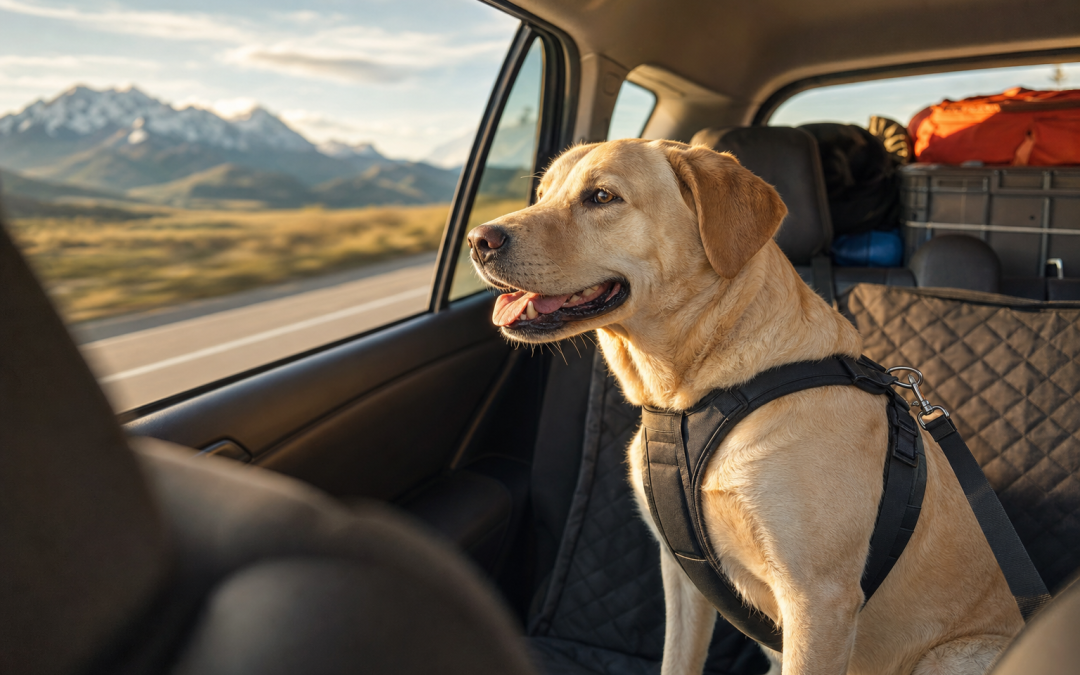
An unrestrained dog in a moving car is a projectile in a crash. In a collision or even a hard stop, a loose dog can be thrown into the seat in front, into a passenger, or through the windshield. Veterinary and highway-safety organisations consistently advise restraining every dog on every trip. The question is which restraint.
This guide covers seven dog car harnesses for 2026 and, more importantly, it separates the ones with independent third-party certification from the ones that are only tested by the brand that sells them. That distinction is the whole point of the category, and most roundups blur it.
Disclosure: This article contains affiliate links. If you buy through our links, we earn a small commission at no extra cost to you. We only recommend gear that meets our research criteria.
Why “crash-tested” and “crash-certified” are not the same thing
The pet industry has no mandatory safety standard for car harnesses. Any manufacturer can say their product is “crash-tested” without saying who tested it, to what standard, or whether it passed. Two very different things hide behind that phrase:
- Manufacturer-commissioned testing. The brand pays a crash lab to run its harness against a test protocol and publishes the result itself. This can be rigorous and honest. It is still the brand marking its own homework, and the brand chooses whether to publish a failure.
- Third-party certification. The Center for Pet Safety (CPS), an independent nonprofit, runs a voluntary certification programme using a protocol adapted from FMVSS 213, the U.S. federal standard for child restraint systems. Certification is awarded by CPS, not by the brand, and CPS publishes which products passed.
Both Ruffwear and Kurgo publish real, lab-run crash data for their car harnesses. Neither is CPS certified, and Ruffwear says so plainly on its own site. That does not make those harnesses bad. It does mean that if independent certification is your decision criterion, the field is much narrower than most articles imply.
One practical note: at the time of writing, the CPS certified-products index lists crates and carriers, and its certified harness records live on individual product pages rather than in that index. Check centerforpetsafety.org directly for the current status of any harness before you buy on the strength of a certification claim, including ours.
The 7 dog car harnesses we recommend for 2026
1. Sleepypod Clickit Sport Plus – Best overall, and CPS certified
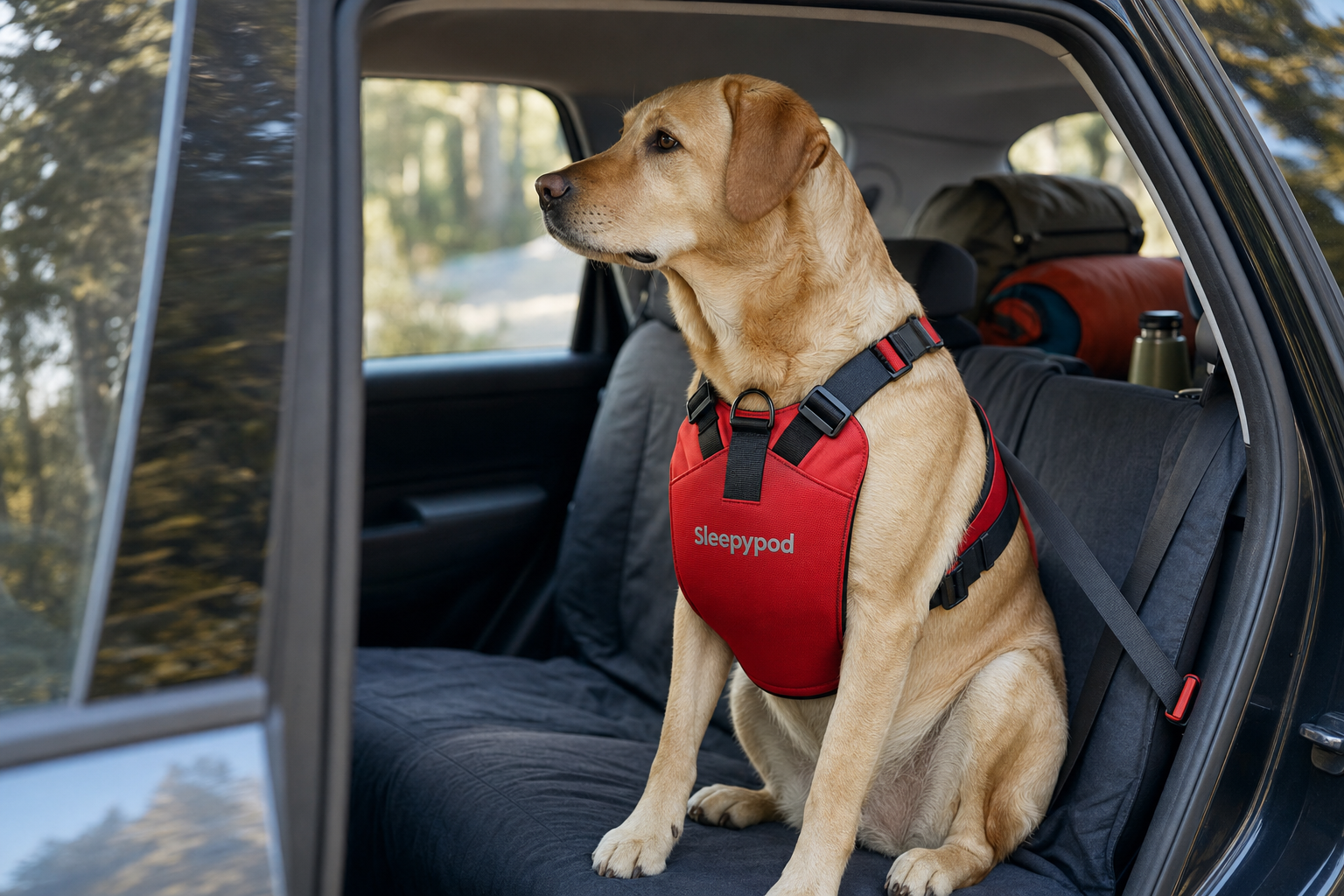
The Sleepypod Clickit line is the most thoroughly documented dog harness on the market and the one clear third-party-certified choice for medium and large dogs. Sleepypod states the harness is crash-tested to the U.S., Canadian and E.U. child safety seat standards (FMVSS 213 in the U.S., CMVSS 213 in Canada and the E.U. child restraint standard) at 30 mph. The Center for Pet Safety separately certified the Clickit Sport at a five-star rating, tested in July 2014.
The design uses a vest-style chest panel that spreads crash force across the dog’s torso rather than the neck, and the vehicle seatbelt routes through a wide loop on the back.
CPS-certified size ratings: Small rated to 25 lbs, Medium rated 45 to 90 lbs, Large rated 75 to 90 lbs, X-Large rated to 90 lbs, per the Center for Pet Safety’s published certification record.
Reported strengths: the only harness in this guide with independent certification across four sizes. Owners report it stays comfortable on long trips.
Reported drawbacks: it is the most expensive harness here, and owners commonly report the sizing runs small. Measure rather than guess. Owners of thick-coated breeds report the chest panel is warm in summer.
2. ZuGoPet Rocketeer Pack – Best for small dogs, and CPS certified
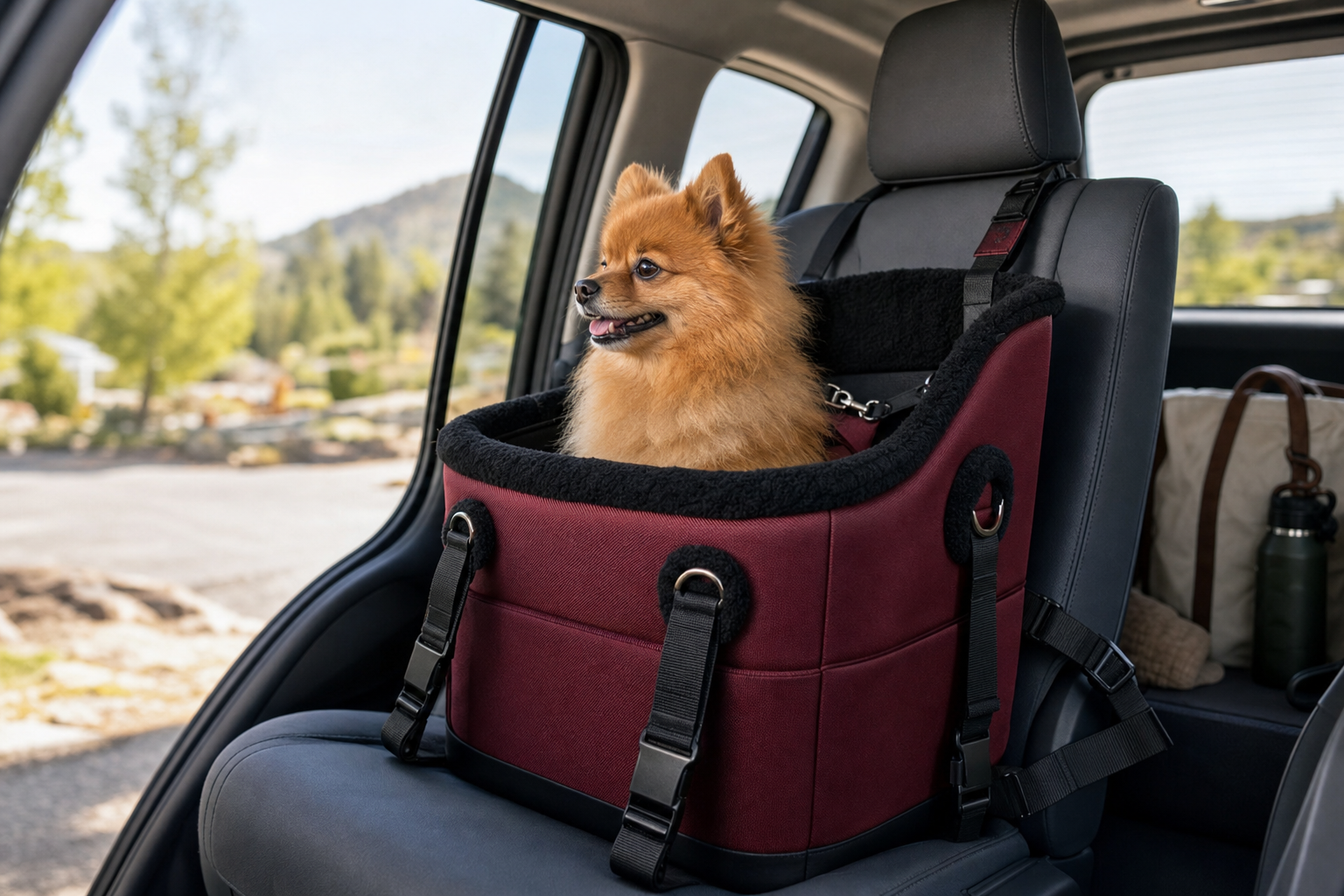
Small dogs need a different approach. Conventional harnesses often carry too much slack to control a 10-pound dog effectively. The Rocketeer Pack is a hybrid carrier and restraint that works as an ordinary carrier outside the car and as a certified safety device inside it.
The Center for Pet Safety certifies the Rocketeer Pack for dogs and cats up to 25 pounds. That ceiling is the certification, not a marketing figure, and it is the reason this is the small-dog pick rather than a general-purpose one.
Best for: dogs and cats up to 25 lbs.
Reported strengths: independent certification at a size where almost nothing else is certified. Doubles as a carrier.
Reported drawbacks: it is a carrier form factor, so dogs that like to sit up and watch out of the window generally do not settle in it as readily.
3. Kurgo Impact – Best value, manufacturer crash-tested
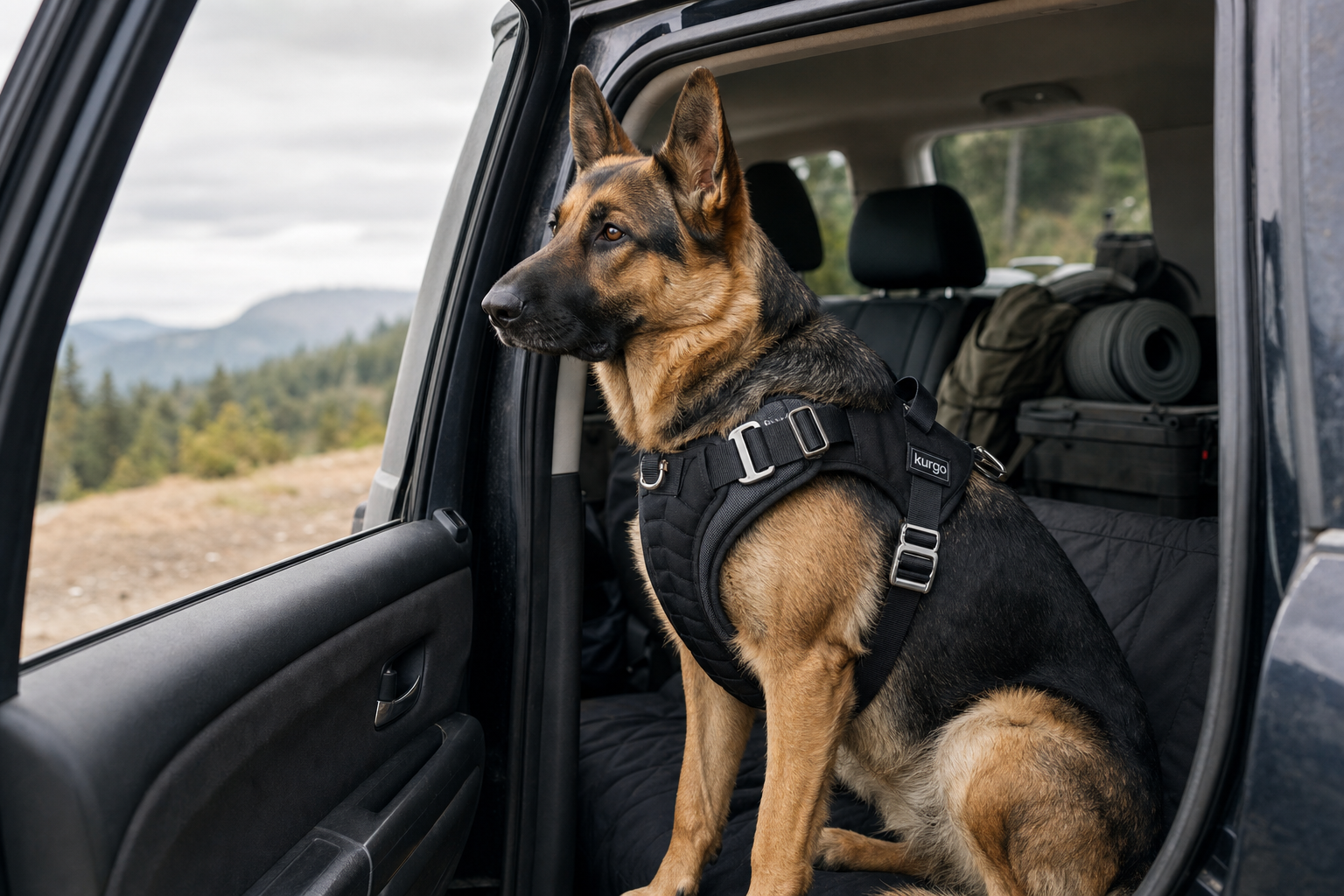
The Kurgo Impact is the strongest value here, provided you understand exactly what its testing does and does not cover. It is not CPS certified. Kurgo publishes its own methodology: the Impact was tested at Calspan’s crash-test facility in Buffalo, New York, using a procedure adapted from FMVSS 213 for child restraint systems, with dog mannequins at 25 lbs, 50 lbs and 75 lbs. Kurgo reports the harness kept its structural integrity and stayed inside the excursion limits it tested against, 32 inches or less for dogs up to 50 lbs and 36 inches or less for dogs between 51 and 75 lbs.
That is a real, published, lab-run test at a recognised facility. It is not an independent certification, and Kurgo does not claim one.
Published test range: mannequins at 25, 50 and 75 lbs. Kurgo lists the harness at $78.95 on its own site.
Reported strengths: steel nesting buckles, padded chest support, transparent published test methodology.
Reported drawbacks: single-point attachment restrains less than the Sleepypod’s vest design. Owners commonly report the sizing chart is confusing. Measure your dog’s chest rather than sizing by weight.
4. Ruffwear Load Up – Best dual-purpose, manufacturer crash-tested
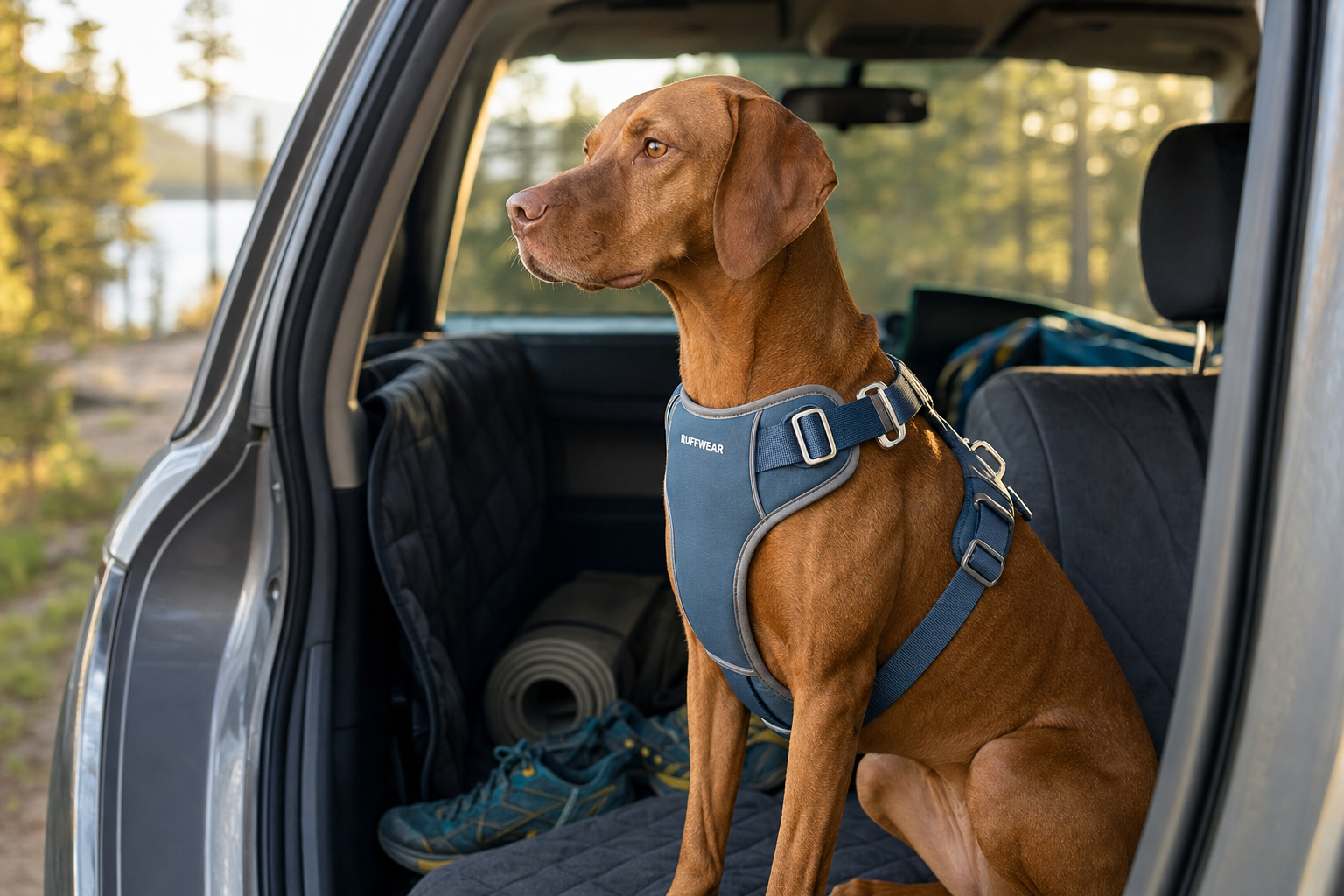
The Load Up overlaps most with hiking gear, so it doubles as a sturdy walking harness at the trailhead. Ruffwear states it was dynamically tested under the conditions set out in FMVSS 213 at MGA Research Corporation, using a 30 mph generic frontal crash pulse with dog mannequins at 25, 45 and 75 lbs.
It is not CPS certified, and Ruffwear says why. On its own testing page, Ruffwear states the Load Up has not been tested against the CPS protocol and would not meet CPS certification on the excursion measurement limits, because the seatbelt attachment point sits lower on the dog’s back for comfort where CPS certification would require it higher. We think that candour is to Ruffwear’s credit, and it is also a real safety trade-off you are choosing.
Sizes: XXS through Large/XLarge, covering girths of 13 to 42 inches.
Reported strengths: genuine dual-purpose car and trail use, strength-rated hardware, padded chest plate.
Reported drawbacks: the lower attachment point that makes it comfortable is the same feature that puts it outside CPS certification. The seatbelt buckle is bulky for dogs that curl up.
5. EzyDog Drive Safety Travel Harness – Comfort-focused, no published third-party test
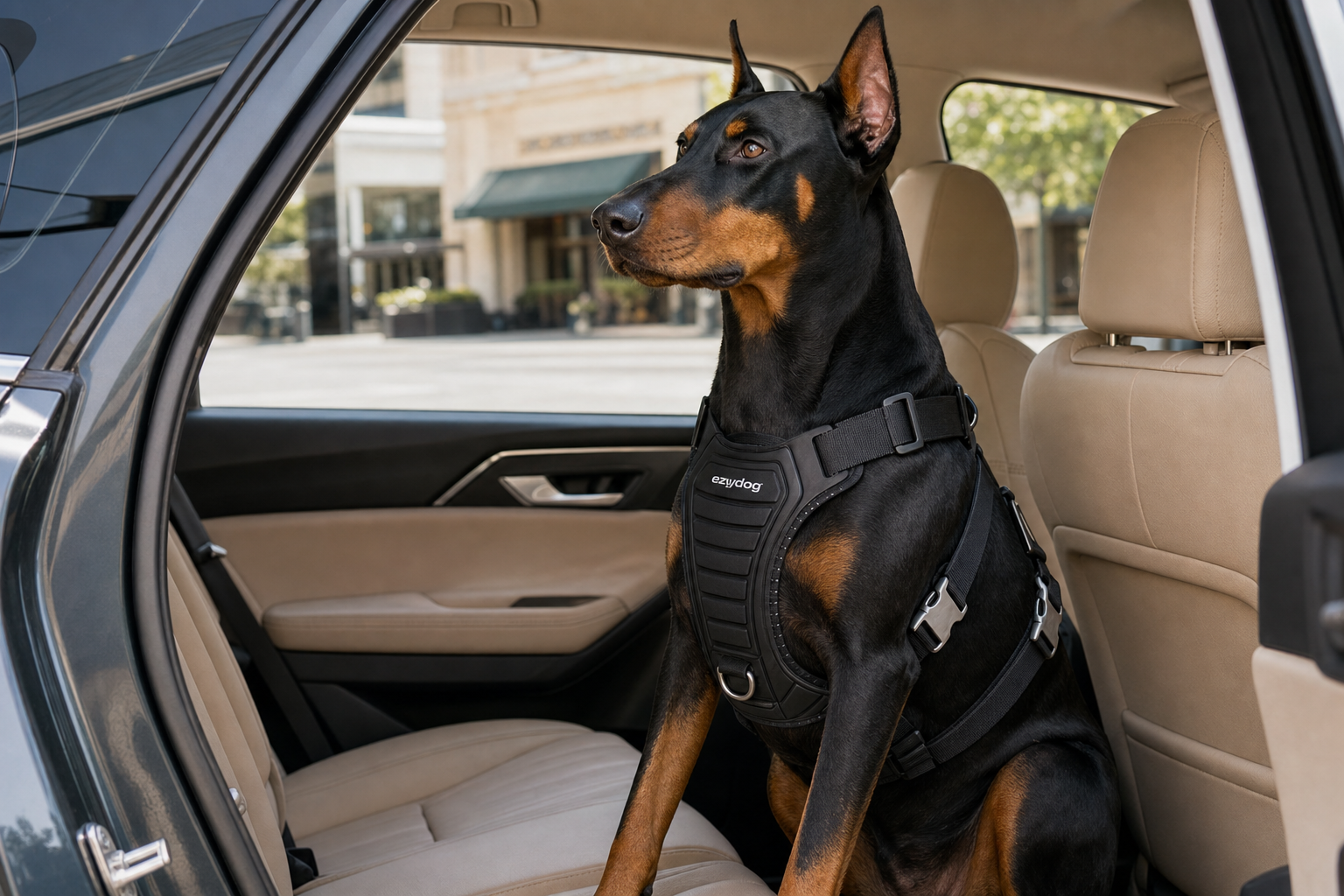
EzyDog’s Drive harness uses a wide webbing system with a chest plate that spreads load across the dog’s sternum. We could not verify any independent crash certification or any published third-party test result for it, so we are not repeating any testing claim for this harness.
Reported strengths: owners consistently describe it as comfortable and breathable on long drives, and easy to fit.
Reported drawbacks: no independent certification we could verify. If crash performance is your deciding factor, choose one of the four above.
6. Mighty Paw Vehicle Safety Harness – Mid-tier restraint, not a crash device
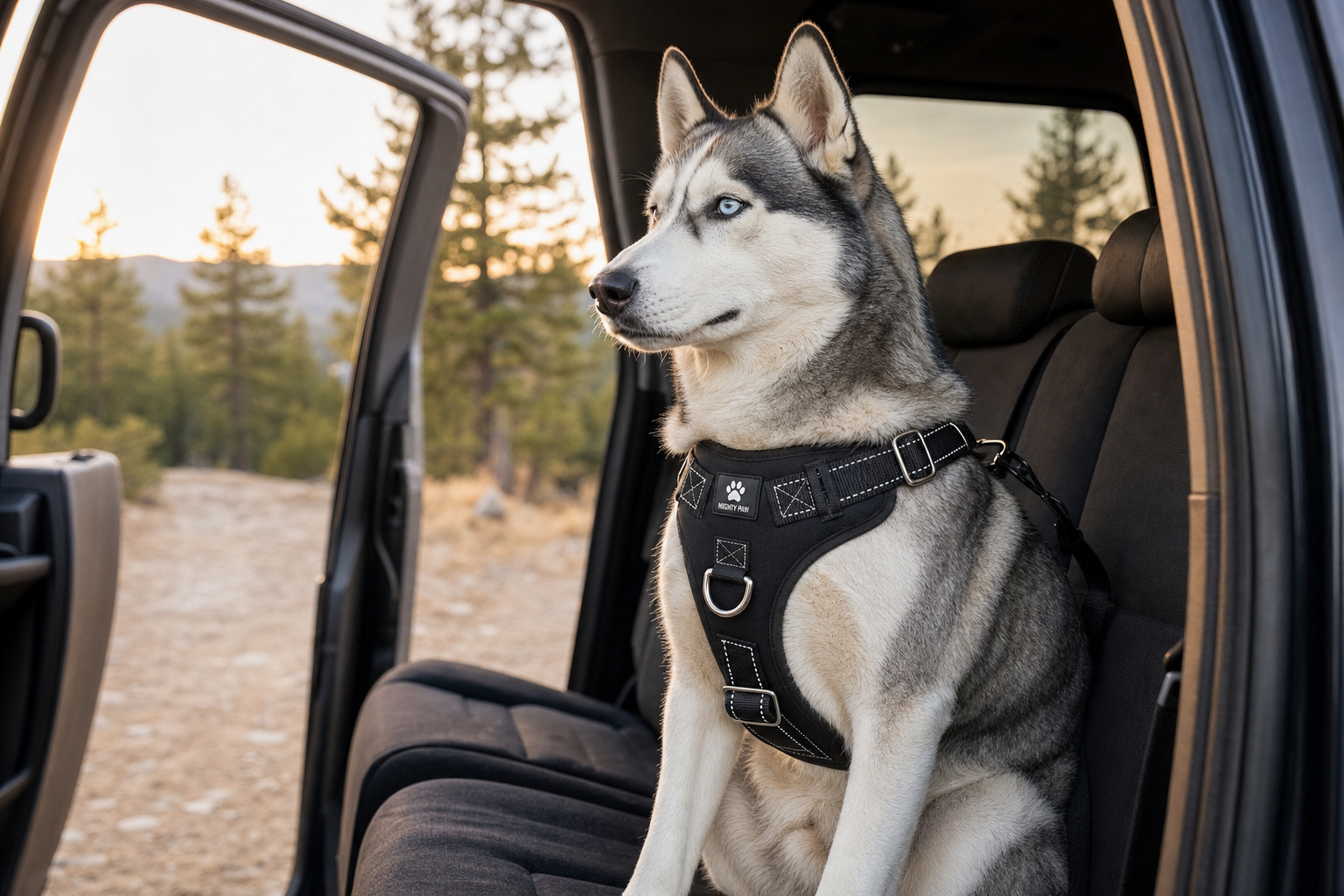
Mighty Paw’s harness sits between the Kurgo Impact and the cheapest options on price, and it uses metal hardware at the seatbelt clip. We found no independent certification and no published crash test result.
Reported strengths: metal seatbelt clip, padded chest, several sizes.
Reported drawbacks: no verifiable crash testing. Treat it as a restraint that stops a dog roaming the cabin, not as a crash-protection device. Owners commonly report the sizing runs large.
7. PetSafe Solvit Deluxe – Budget restraint, not a crash device
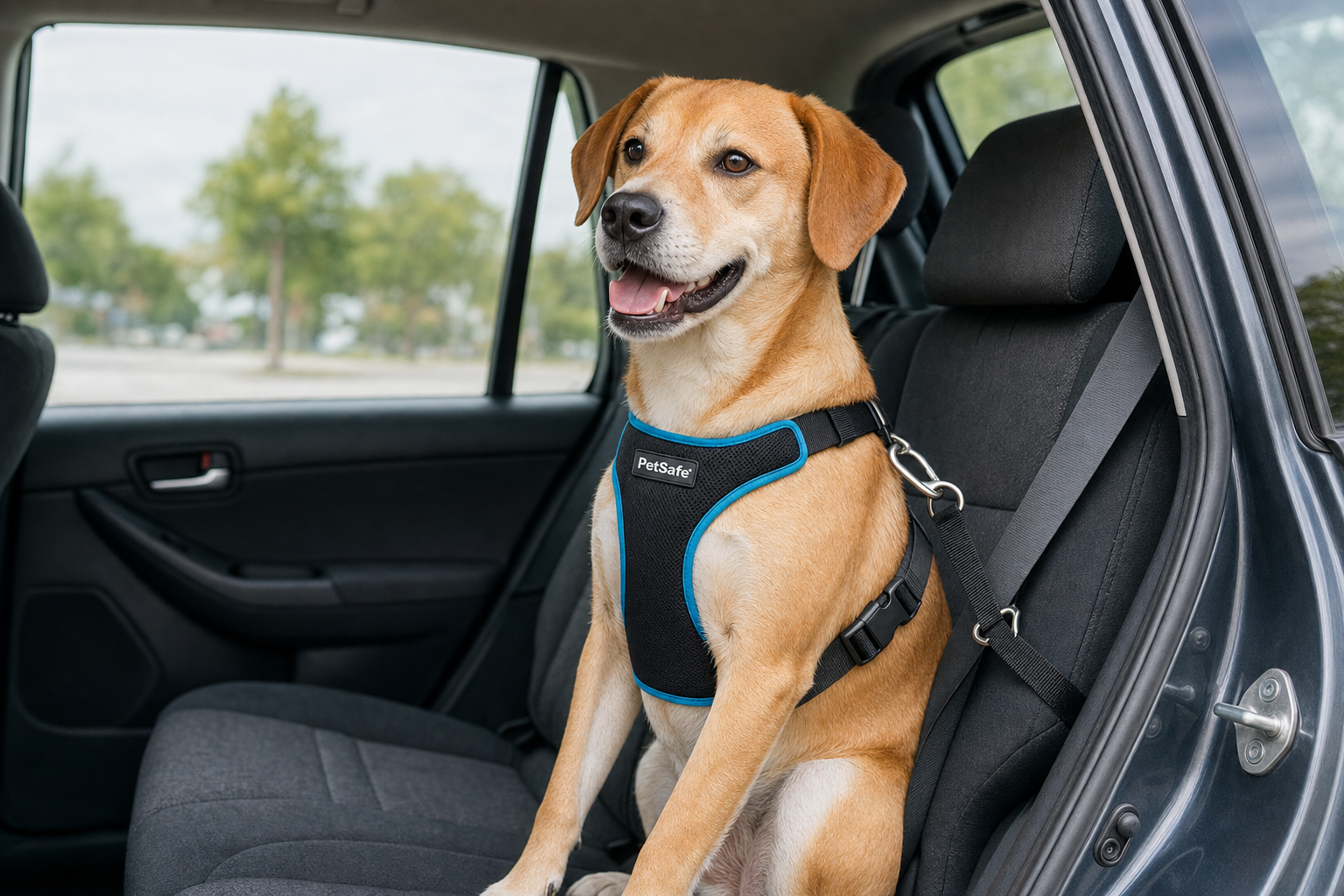
The Solvit Deluxe is the cheapest option we are willing to list, and we list it only because some restraint beats none. It has no certification and no published crash test that we could verify.
Reported strengths: inexpensive, adjustable, comfortable for short trips.
Reported drawbacks: plastic components at the seatbelt attachment are the obvious weak point. If you drive highways regularly, spend up to the Kurgo Impact.
How to size a dog car harness correctly
The biggest mistake in dog car harnesses is sizing by weight. Two dogs of the same weight can have very different chest sizes. Always measure.
- Chest circumference: measure around the widest part of the chest, just behind the front legs. This is the critical measurement.
- Neck circumference: measure at the base of the neck where a collar sits.
- Back length: from the base of the neck to the base of the tail.
Compare your measurements to the manufacturer’s chart for that specific harness, not a generic chart. If you fall between sizes, follow the manufacturer’s own guidance for that model rather than a general rule, because the brands differ on this.
Where to attach in your vehicle
The back seat is safer than the front. Avoid the front passenger seat: airbag deployment can injure or kill a dog of any size.
Use the rear seatbelt that corresponds to where your dog rides. Route it through the harness’s seatbelt loop and click the belt into the buckle as you would for a person. Make sure the belt is snug, with minimal slack.
Comparison table
| Harness | CPS certified | Manufacturer-published crash test | Verified size or weight guidance | Best for |
|---|---|---|---|---|
| Sleepypod Clickit Sport Plus | Yes, five-star | FMVSS 213, CMVSS 213 and E.U. child seat standards at 30 mph | CPS ratings: S to 25 lbs, M 45-90 lbs, L 75-90 lbs, XL to 90 lbs | Overall safety |
| ZuGoPet Rocketeer Pack | Yes | See CPS record | CPS certified up to 25 lbs | Small dogs and cats |
| Kurgo Impact | No | Calspan, procedure adapted from FMVSS 213 | Tested at 25, 50 and 75 lbs | Value |
| Ruffwear Load Up | No, and Ruffwear states it would not meet CPS excursion limits | MGA Research, FMVSS 213 conditions, 30 mph, 25/45/75 lb mannequins | Girth 13-42 in across XXS to L/XL | Car and trail dual use |
| EzyDog Drive | No | None we could verify | See manufacturer chart | Long-haul comfort |
| Mighty Paw | No | None we could verify | See manufacturer chart | Mid-tier restraint |
| PetSafe Solvit Deluxe | No | None we could verify | See manufacturer chart | Budget restraint |
Frequently asked questions
Can I use a regular walking harness as a car restraint?
No. Walking harnesses are not designed or tested for crash forces. Use a harness specifically designed and tested for vehicle use.
What about a dog crate in the car?
A properly anchored crash-tested crate is generally considered the strongest option, more so than any harness. The Center for Pet Safety currently certifies crates including the Gunner G1 kennel in Small, Medium and Intermediate, the Lucky Duck Lucky Kennel in Medium, Intermediate and Large, and the Cabela’s GunDog Kennel in Intermediate and Large. The downside is bulk, cost, and the need to anchor the crate to the cargo area. We cover crates in our travel crate guide.
Are dog car seats safe?
Most pet booster seats marketed for small dogs carry no independent certification. They are containment devices, not tested safety devices. For small dogs, the CPS-certified ZuGoPet Rocketeer Pack is the one certified option we recommend, up to its certified 25-pound limit.
How do I introduce my dog to a car harness?
Put the harness on the dog at home, with treats and praise, for short periods before any car trip. Build up to wearing it during meals, then short stationary sessions in the parked car, then short drives. Trainers generally advise going at the dog’s pace rather than to a fixed schedule.
Do I really need a harness if my dog stays still in the car?
Yes. A calm dog in a crash is subject to the same forces as an excited one. The harness is not for behaviour management. It is for crash forces, which apply regardless of how well trained your dog is.
The bottom line
If independent certification is what you are buying, the honest answer is that the certified field is small. For medium and large dogs the Sleepypod Clickit Sport Plus is the CPS-certified choice, rated by CPS up to 90 lbs depending on size. For dogs and cats up to 25 lbs, the ZuGoPet Rocketeer Pack is the CPS-certified choice.
If you are weighing cost against certification, the Kurgo Impact and the Ruffwear Load Up both publish genuine crash-lab results and neither is CPS certified. Pick the Kurgo for value and the Ruffwear if you want one harness for the car and the trail. Just do not buy either believing it carries third-party certification, because it does not.
Whatever you choose, the most important thing is to use it on every trip. Even a short drive at city speed can produce forces that injure or kill an unrestrained dog. The best harness in the world does nothing in the closet.
Related guides: